
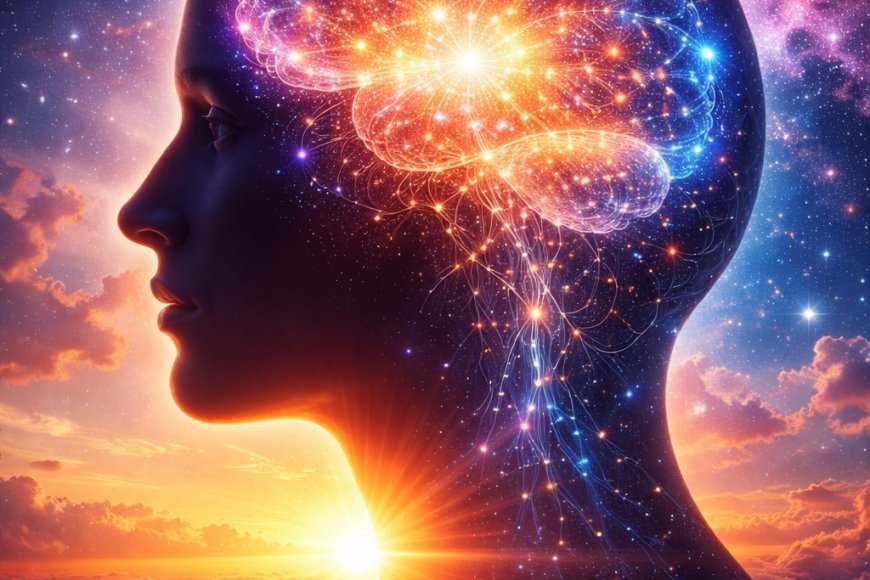
Close your eyes and think about the color red. Feel the warmth of the sun on your skin. Listen to your favorite song.
These experiences seem simple, almost trivial. Yet they represent one of the greatest mysteries in all of science—perhaps the greatest mystery. How does a three-pound lump of fatty tissue, firing electrical signals, produce the feeling of being you?
This is the realm of Consciousness Studies, a field where neuroscientists meet philosophers, and where data meets deep introspection. In this edition of Frontier Science, we tackle the Hard Problem, investigate the evidence for life after death, and consider a radical idea: what if the universe itself is conscious?
Part I: The Hard Problem — Why Is There "Something It Is Like" to Be You?
In the 1990s, philosopher David Chalmers drew a famous distinction that frames the entire field of consciousness studies. He called it "The Hard Problem."
To understand it, we must first acknowledge the "Easy Problems." These aren't easy in the sense of being simple, but they are easy in principle to solve with standard science. For example:
-
How do neurons fire?
-
How does the brain process visual information?
-
How do we store and recall memories?
We can, in theory, map these processes, measure them, and explain them through biology and physics.
The Hard Problem is different.
It asks: Why is all this neural processing accompanied by experience? Why does the processing of light waves on your retina result in the feeling of seeing a deep blue sky? Why does a chemical reaction in your brain result in the ache of heartbreak?
Chalmers put it this way: "Even when we have explained the performance of all the cognitive and behavioral functions, there is still a further mystery: why is the performance of these functions accompanied by experience?"
Science can explain what the brain does. It struggles to explain what the brain feels like from the inside. That "inside-ness" is the Hard Problem, and it remains one of the most exciting open questions in Frontier Science.
Part II: Near-Death Experiences — Glimpses of Beyond?
If the Hard Problem asks how the brain creates consciousness, Near-Death Experiences (NDEs) ask the inverse: What happens to consciousness when the brain shuts down?
For decades, stories of people "dying" and coming back were dismissed as hallucinations or wishful thinking. But modern resuscitation science has changed the conversation.
What Happens During an NDE?
Patients who have been clinically dead (no heartbeat, no brain activity) and then revived sometimes report strikingly similar experiences:
-
A feeling of profound peace and the absence of pain.
-
An out-of-body experience, often floating above their own body and observing medical procedures.
-
Traveling through a tunnel toward a brilliant, loving light.
-
A life review, where they re-experience every moment of their life from a moral perspective.
The Scientific Debate:
-
Skeptics argue: These experiences are the result of the brain firing randomly as it dies, specifically the release of DMT-like chemicals or oxygen deprivation (hypoxia). They are the brain's last gasp.
-
Proponents (and some open-minded researchers) argue: This doesn't explain the "veridical perceptions"—cases where patients accurately describe events that happened in the room (e.g., the specific tools doctors used, conversations that occurred) while they were clinically dead and supposedly unable to see or hear.
Dr. Sam Parnia's AWARE studies (AWareness during REsuscitation) have attempted to test this by placing images on high shelves in hospital rooms—only visible from the ceiling. If a patient who had an NDE could describe the image, it would be powerful evidence that consciousness can operate outside the body.
The results are inconclusive, but the research continues. For now, NDEs remain a fascinating frontier—a potential bridge between neuroscience and the possibility that consciousness is more than just brain activity.
Part III: Panpsychism — A Conscious Universe?
If the Hard Problem seems impossible, and NDEs seem too spooky, there is a third path gaining traction in both philosophy and theoretical physics: Panpsychism.
This is not new-age mysticism. It is a serious philosophical position with ancient roots (found in Buddhism and Stoicism) and modern proponents like philosophers Galen Strawson and David Chalmers.
The Core Idea:
Panpsychism is the view that consciousness is a fundamental and ubiquitous feature of the universe, like mass, spin, or electric charge.
Think about it this way: Science has shown us that life is not a magical substance added to matter. Living things are just complex arrangements of non-living atoms. Similarly, panpsychism suggests that experience is not a magical substance added to complex brains. Instead, all matter has a "proto-conscious" aspect.
-
A rock wouldn't have thoughts or feelings, but it would have a tiny, unimaginably simple "point of view."
-
A human brain, being vastly more complex, combines these fundamental units of experience into the rich, unified consciousness we know.
Why Consider It?
Panpsychism elegantly solves the "combination problem" (how micro-experiences combine into one macro-experience) and avoids the trap of believing consciousness magically "appears" only when matter reaches a certain level of complexity (like the human brain).
It suggests that consciousness isn't something the brain produces, like the liver produces bile. It's something the brain organizes and channels.
Conclusion: The Frontier Within
We began by asking how the brain creates the feeling of being alive. But perhaps we asked the wrong question.
Perhaps the brain is not a generator of consciousness, but a receiver—a complex antenna tuning into a field of consciousness that is everywhere. Perhaps NDEs occur when the receiver, damaged by trauma, briefly picks up a signal from somewhere else. Perhaps the Hard Problem is hard because we are trying to catch our own tail—consciousness trying to explain itself using itself.
The study of consciousness is the ultimate Frontier Science. It sits at the edge of measurable data and pure mystery, forcing us to question not just the world, but the very instrument we use to perceive it.
What do you think? Is consciousness just brain chemistry? A glimpse of the divine? Or a fundamental property of the universe itself? Join the conversation in the comments below. And if you enjoyed this deep dive, share it with someone who loves to wonder.