
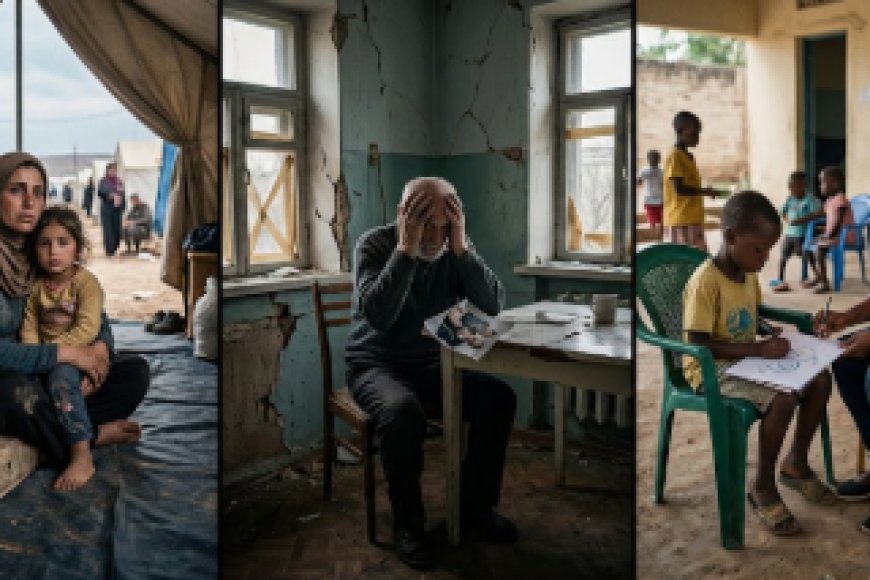
War doesn’t stay where it starts.
Even when the fighting is “over there,” the psychological shockwaves travel everywhere — through families, economies, screens, schools, and the nervous systems of people who never stepped onto a battlefield.
At Mokwe Press, we don’t do political campaigning. We focus on independent research, human impact, and what conflict does to real lives. This is about humanity — not sides.
Below are some of the most common and most overlooked ways war can affect mental health globally, across both direct and indirect exposure.
-
Trauma Becomes Widespread — Even for Those Who Didn’t Experience Combat
For people living through conflict, the mental health impact can be severe: PTSD, depression, complicated grief, panic disorders, insomnia, and dissociation are all common. But trauma can also spread through families and communities long after the physical danger ends.
Children growing up in war zones often develop stress responses that become “normal” to them — hypervigilance, emotional numbing, and difficulty trusting safety. Adults may carry chronic fear, survivor’s guilt, and a constant sense of instability that persists for years.
-
Displacement Creates Long-Term Psychological Stress
War creates refugees and displaced communities, and displacement isn’t only a physical loss — it’s an identity shock.
When someone loses:
• their home
• their routine
• their community
• their language environment
• their sense of stability
the brain responds with prolonged stress.
This can increase depression, anxiety, substance misuse, and family strain. And even after relocation, uncertainty around legal status, work, discrimination, and cultural isolation can keep the nervous system stuck in survival mode.
-
“Secondhand War Stress” Through Media Exposure
In modern conflict, people worldwide experience war through constant video clips, headlines, and graphic imagery — sometimes daily.
This is not neutral for the brain.
Repeated exposure to violent content can cause:
• chronic anxiety
• sleep disruption
• emotional exhaustion
• desensitization (numbing)
• fear-based thinking and doom scrolling cycles
Even when someone isn’t directly threatened, the body can still process the imagery as danger — because the nervous system responds to what it sees as if it’s present.
-
Economic Shock and Instability Increase Anxiety Worldwide
Wars can disrupt:
• fuel prices
• food supplies
• manufacturing
• shipping routes
• job markets
• inflation levels
These pressures increase stress far outside the conflict zone.
When people can’t predict costs or stability, mental health declines — especially for low-income households and communities already living on thin margins. Financial instability is strongly tied to anxiety, depression, relationship conflict, and increased burnout.
-
Families Absorb the Burden — Even Across Borders
War stress doesn’t stop at the frontline. Families everywhere feel it:
• military families navigating deployment and reintegration
• immigrants and diaspora communities fearing for relatives back home
• children processing heavy topics in school
• communities coping with grief and uncertainty
In many cases, people experience “anticipatory grief” — mourning something that hasn’t happened yet, because they’re living in constant dread.
-
Social Division, Fear, and Distrust Can Rise Globally
When conflict is intense, societies often become psychologically reactive:
• increased suspicion
• increased aggression or hostility online
• scapegoating and stereotyping
• decreased empathy over time
Under stress, people tend to simplify complex reality into “us vs them” thinking. That can damage communities even in countries not directly involved in war.
-
Long-Term Effects: A Generation Carries It Forward
War doesn’t only harm current mental health — it can shape future generations through:
• intergenerational trauma
• disrupted education
• normalized instability
• increased domestic violence in some settings
• lost opportunities and chronic stress exposure
A child who learns that life can collapse overnight may grow into an adult who struggles to trust peace.
What Can Help (Without Pretending It’s Simple)
No single coping tip fixes war. But there are actions that reduce psychological harm:
• Limit graphic media exposure (especially before sleep)
• Focus on verified news and avoid doom scrolling loops
• Stay connected to real people offline
• Use community support: faith groups, mutual aid, counseling, peer circles
• For refugees and survivors: trauma-informed therapy and culturally safe support
• For parents: age-appropriate conversations, stability routines, emotional check-ins
• For everyone: sleep, hydration, movement, and nervous system regulation matter more than people think
Final Word
War is not only a political event — it’s a psychological event.
It changes the way humans perceive safety, time, trust, identity, and tomorrow. Even across oceans, conflict can reshape mental health through fear, economic instability, media saturation, displacement, and collective grief.
Understanding these effects doesn’t solve war — but it does help us protect humanity while the world shakes.