
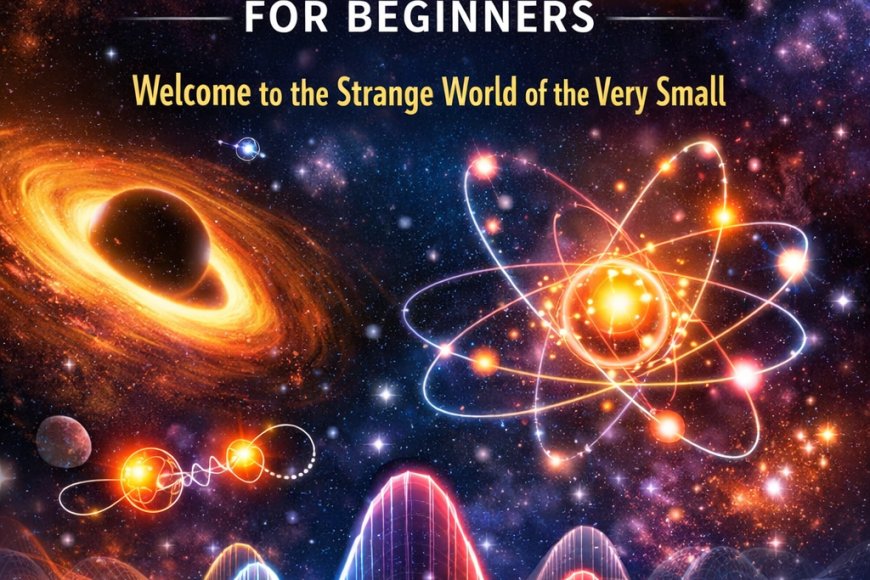
Imagine throwing a baseball at a wall. You know exactly where it will go and where it will land. Now, imagine that same baseball passing through the wall, or being in two places at once, or not truly existing until you look at it.
This isn’t science fiction. This is the everyday reality of the quantum world—the strange and fascinating set of rules that govern atoms, photons, and everything smaller.
Welcome to Quantum Physics & Mechanics, the first stop on our journey into the "Frontier Science."
1. What is Quantum Mechanics? (In Plain English)
At its core, quantum mechanics (also called quantum physics or quantum theory) is the branch of science that deals with the world of the very, very small.
While "classical physics" (the rules invented by Newton) explains why an apple falls from a tree, quantum physics explains why the sun shines, how your phone's computer chip works, and why atoms don't just collapse.
The word "quantum" itself comes from the Latin for "how much"—because scientists discovered that energy at this level comes in tiny, discrete packets (quanta) rather than one continuous stream.
2. The "Weird" Rules of the Game
To understand why this topic fits under "Frontier Science," you have to accept that the universe at this level plays by completely different rules. Here are the three most famous (and mind-bending) concepts:
A. Wave-Particle Duality (Light is Two Things)
For centuries, scientists argued: Is light a wave or a particle? The quantum answer? Yes.
Experiments show that a tiny particle like an electron behaves as a solid ball and a spread-out wave at the same time. It only "chooses" which one to be when we try to measure it. This leads us to...
B. The Observer Effect (Reality Needs a Look)
This is the one that drives philosophers crazy. In the quantum world, particles don't have fixed properties (like location or speed) until they are observed.
Think of it like a spinning coin. While it's spinning, it's neither heads nor tails—it's a blur of potential. Only when it lands (or is "measured") does it pick one. At the quantum level, reality seems to exist in a blur of potential until something (or someone) observes it.
C. Quantum Entanglement ("Spooky Action at a Distance")
Einstein famously hated this one. If you create two particles that are "entangled," they become linked forever, no matter how far apart they travel.
If you change one particle here on Earth, its twin—even if it is on the other side of the galaxy—changes instantly. Not faster than light, but instantly. Einstein called it "spooky," but we now know it's a real phenomenon.
3. Why Should You Care? (Real-World Applications)
This isn't just academic navel-gazing. Understanding and harnessing these weird rules has given us:
-
The Transistor: Every computer, smartphone, and modern gadget relies on chips built using quantum principles.
-
Lasers: From eye surgery to fiber-optic internet, lasers (which rely on quantum physics) run our world.
-
MRI Machines: Used in hospitals to see inside your body safely.
-
The Future - Quantum Computers: While standard computers use "bits" (0 or 1), quantum computers use "qubits" (which can be 0 and 1 at the same time). This will allow us to solve problems in medicine and climate science that would take today's computers millions of years.
The Frontier: Where Quantum Meets Metaphysics
This is where we enter the territory that makes Frontier Science so exciting. If particles don't "exist" until we observe them, what does that say about reality?
-
Is consciousness required for the universe to exist?
-
If two particles can be connected across the universe, what does that mean for our understanding of space and time?
Quantum physics doesn't have the answers to these questions yet—but it has proven that the universe is far stranger, and far more connected, than we ever imagined.
Call to Action:
Have a question about the nature of reality? Want us to dive deeper into Quantum Entanglement or the rise of Quantum Computing? Let us know in the comments or suggest a topic for the next Frontier Science article!